
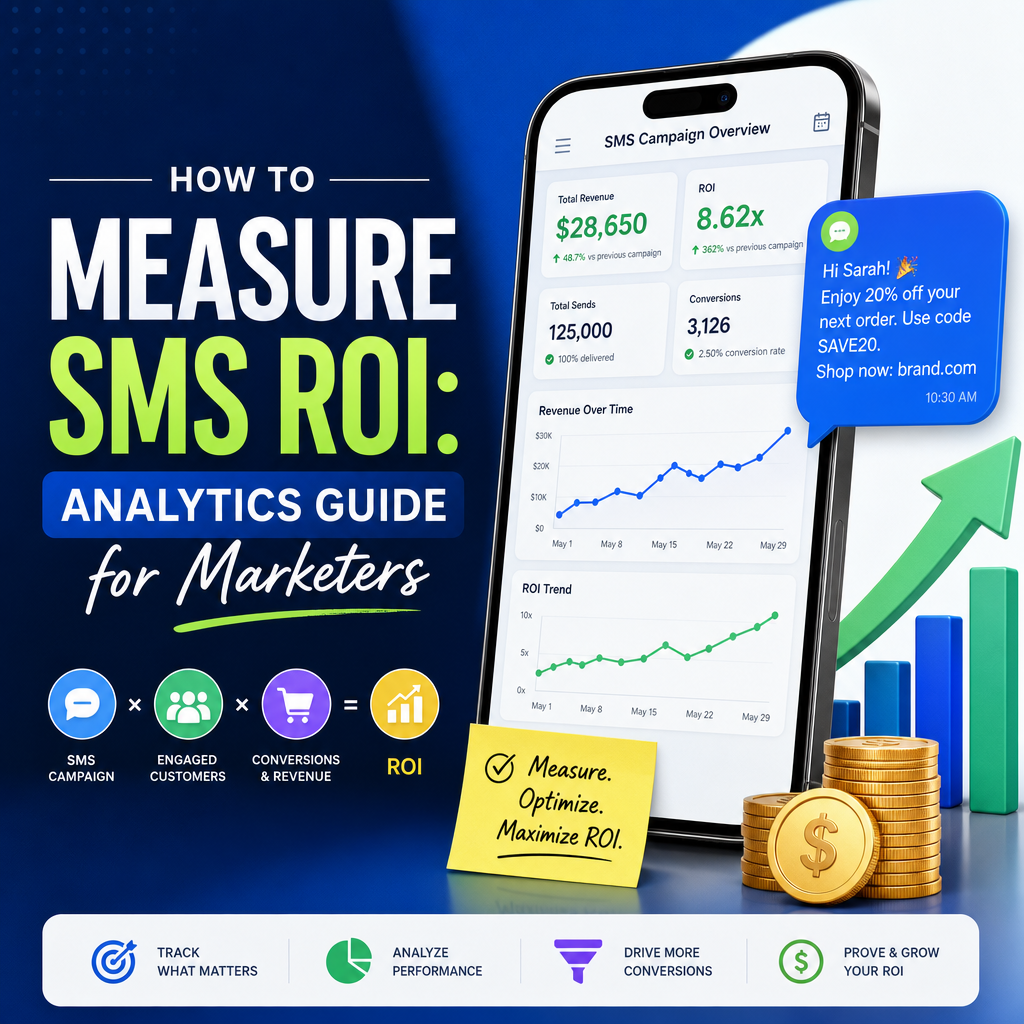
How to Measure SMS Marketing ROI
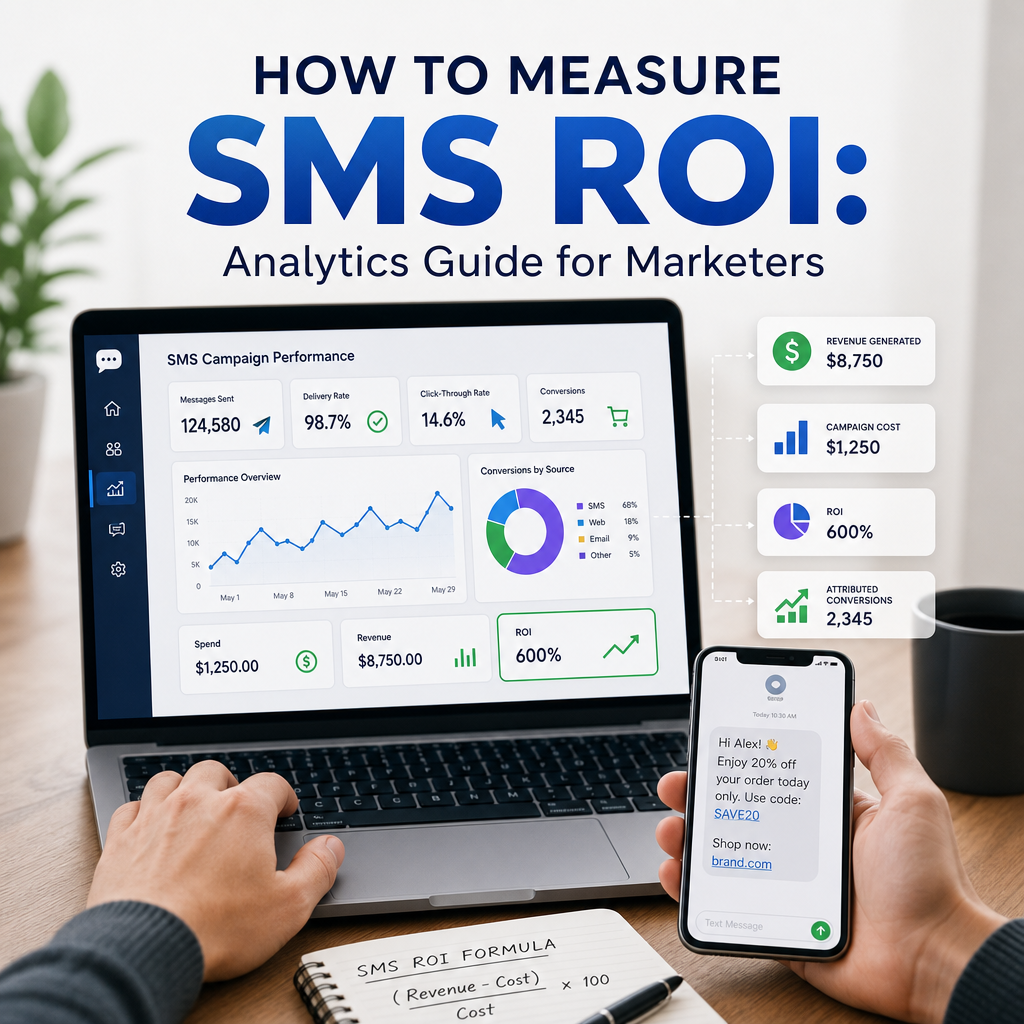
SMS marketing is one of the most direct ways to reach customers. Messages are opened quickly, responses are often immediate, and campaigns can drive sales in a short time. But sending texts is only valuable if you can prove they generate profit. That is where sms roi comes in.
Measuring SMS marketing ROI helps you answer a simple but critical question: Is this channel making money for the business? By tracking the right metrics and using the right analytics, you can identify which campaigns work, which ones waste budget, and how to improve results over time.
In this guide, we’ll break down how to measure SMS marketing ROI step by step, which numbers matter most, and how to calculate whether your campaigns are truly paying off.
What Is SMS Marketing ROI?
ROI stands for return on investment. In SMS marketing, ROI compares the revenue generated by your text campaigns to the total cost of running them.
A positive ROI means your SMS marketing is earning more than it costs. A negative ROI means you are spending more than you are making back.
At its simplest, the formula looks like this:
ROI = (Revenue from SMS – Cost of SMS) / Cost of SMS × 100
For example, if you spend $500 on an SMS campaign and it brings in $2,000 in revenue, your ROI is:
($2,000 – $500) / $500 × 100 = 300%
That means for every $1 spent, you earned $4 in revenue total, or $3 in profit beyond the original investment.
Why Measuring SMS ROI Matters
It is easy to assume SMS works because it has high open rates and fast response times. But those metrics alone do not tell you whether a campaign is profitable.
Measuring ROI gives you:
- A clear view of profitability – You know whether your texts are generating more money than they cost.
- Better budgeting decisions – You can invest more in campaigns that perform well and cut those that do not.
- Smarter optimization – You can test offers, timing, and audience segments based on performance data.
- Stronger reporting – You can show stakeholders the real business impact of SMS marketing.
- Improved customer strategy – You can learn which messages motivate action and which ones get ignored.
Without ROI tracking, SMS marketing becomes guesswork. With it, you can turn a simple channel into a measurable growth engine.
Step 1: Define Your Campaign Goal
Before you calculate roi, you need to know what success looks like. Different SMS campaigns serve different purposes, and each one should be evaluated against the right outcome.
Common SMS goals include:
- Driving online sales
- Promoting in-store visits
- Increasing bookings or appointments
- Recovering abandoned carts
- Promoting event registrations
- Generating repeat purchases
- Re-engaging inactive customers
A discount code campaign, for example, should be judged by sales and revenue. A reminder message for appointments may be measured by attendance rates and avoided no-shows, which translate into saved revenue.
If you do not define the goal first, you may track the wrong numbers and misjudge performance.
Step 2: Track All Campaign Costs
To measure sms roi accurately, you need to capture every cost connected to the campaign. Many businesses only count the price of sending texts, but that often underestimates the true investment.
Include costs such as:
- SMS platform subscription fees
- Per-message sending costs
- Campaign setup or automation tools
- Copywriting and design time
- Promotional discounts offered in the campaign
- Staff time spent planning, managing, or analyzing the campaign
- Landing page or technical development costs, if applicable
For example, if you run a holiday campaign and offer 15% off, that discount should be included as part of the cost because it reduces profit.
Example of campaign cost calculation
Suppose your SMS campaign includes:
- Platform fee: $100
- Message sending cost: $75
- Staff time: $150
- Discount costs: $200
Total cost = $525
This is the number you will use in your ROI formula.
Step 3: Track Revenue Generated by SMS
The most important part of the equation is revenue. You need a way to connect sales or conversions directly to your SMS campaign.
Here are some common ways to track revenue:
Use unique discount codes
A unique coupon code tied to a specific campaign is one of the easiest ways to track sales. If customers use the code at checkout, you know the sale came from the text message.
Use tracked links
Include a unique URL with UTM parameters in your SMS. These let you see how many people clicked the link and what actions they took afterward in your web analytics tools.
Use dedicated landing pages
Sending subscribers to a page built specifically for the campaign makes it easier to measure conversions and isolate performance.
Use response tracking
If your campaign asks customers to reply to a text, you can track responses and follow up with a sales team or automation flow.
Match orders to customer lists
For more advanced tracking, you can compare customer purchase data against SMS recipients to see which users bought after receiving a message.
Example of revenue calculation
Imagine you send a flash sale text to 5,000 subscribers. The campaign generates:
- 120 purchases
- Average order value: $45
Revenue = 120 × $45 = $5,400
That is the revenue amount you use in the ROI formula.
Step 4: Measure the Right Supporting Metrics
Revenue and cost are the core ingredients of ROI, but additional metrics help you understand why a campaign performed the way it did. Strong analytics reveal where to improve future performance.
Useful SMS metrics include:
- Delivery rate – The percentage of texts successfully delivered
- Open rate – SMS typically has very high open rates, which show message visibility
- Click-through rate (CTR) – The percentage of recipients who clicked your link
- Conversion rate – The percentage who completed the desired action
- Redemption rate – How many people used a coupon or offer
- Unsubscribe rate – How many recipients opted out after the campaign
- Revenue per recipient – Total revenue divided by the number of people messaged
- Average order value (AOV) – Average spend per transaction
These metrics help you understand whether the issue is the audience, the message, the offer, or the landing page.
For example:
- A high click-through rate but low conversion rate may point to a weak landing page.
- A low click-through rate may mean your offer is not compelling.
- A high unsubscribe rate may indicate message fatigue or poor targeting.
Step 5: Calculate SMS ROI
Once you have your total revenue and total cost, you can calculate roi.
Basic ROI formula
ROI = (Revenue – Cost) / Cost × 100
Example 1: Positive ROI
- Revenue from SMS: $5,400
- Total campaign cost: $525
ROI = ($5,400 – $525) / $525 × 100
ROI = 928.6%
This means the campaign made nearly 9.3 times more than it cost.
Example 2: Lower but still profitable ROI
- Revenue from SMS: $1,200
- Total campaign cost: $600
ROI = ($1,200 – $600) / $600 × 100
ROI = 100%
This means the campaign doubled the investment.
Example 3: Negative ROI
- Revenue from SMS: $400
- Total campaign cost: $600
ROI = ($400 – $600) / $600 × 100
ROI = -33.3%
This means the campaign lost money.
Step 6: Compare ROI Across Campaign Types
Not all SMS campaigns should be judged the same way. A welcome series, flash sale, cart reminder, and event alert may all produce different levels of return.
When comparing campaigns, look at:
- ROI by campaign type
- ROI by audience segment
- ROI by offer type
- ROI by time sent
- ROI by message length or copy style
For example, you may discover that abandoned cart reminders produce a much better sms roi than general promotional blasts. That insight helps you prioritize automation over one-off sends.
Example comparison
| Campaign Type | Cost | Revenue | ROI |
|---|---|---|---|
| Flash sale | $500 | $3,000 | 500% |
| Cart reminder | $200 | $2,400 | 1,100% |
| Welcome series | $300 | $900 | 200% |
Even though all three campaigns are profitable, the cart reminder performs best relative to cost.
Step 7: Use Analytics to Improve Future ROI
Measuring ROI is only useful if you use the data to make better decisions. This is where analytics play a major role.
Segment your audience
Not every subscriber has the same preferences or purchase behavior. Segmenting by location, purchase history, interests, or engagement level can improve response rates.
For example, a clothing retailer might send one offer to frequent buyers and a different one to first-time shoppers. If one segment generates stronger ROI, you can focus more budget there.
Test message content
A/B testing helps you compare different versions of a text message. Try variations in:
- Call to action
- Offer type
- Message tone
- Personalization
- Emoji use
- Timing
For example, “Shop now and save 20%” might outperform “Limited-time offer: 20% off today only.” Testing lets you see what actually drives clicks and sales.
Optimize send time
The timing of your message can affect engagement and conversions. Some audiences respond better in the morning, while others convert more in the evening or on weekends.
By reviewing analytics from previous campaigns, you can identify the times that produce the highest ROI.
Refine offers
Sometimes the issue is not the SMS channel, but the offer itself. A weak incentive may produce clicks but little revenue. A stronger offer can improve conversion rates significantly.
Examples of stronger offers include:
- Free shipping
- Limited-time bundles
- Buy-one-get-one deals
- VIP early access
- Loyalty rewards
Improve landing pages
If your SMS drives traffic but not sales, the landing page may be the problem. A strong landing page should match the message, load quickly, and make the next step obvious.
Common Mistakes That Distort SMS ROI
Accurate ROI depends on accurate data. Avoid these common mistakes:
Counting only message costs
If you ignore labor, tools, and discounts, your ROI will look better than it really is.
Failing to track attribution
If you cannot connect sales to a specific campaign, you may overestimate or underestimate results.
Using vanity metrics only
Open rates and clicks are useful, but they do not equal profit. Focus on conversions and revenue.
Ignoring customer lifetime value
Some SMS campaigns generate a sale now and additional purchases later. If you only measure immediate revenue, you may miss the full value of the campaign.
Over-messaging your audience
Sending too many texts can increase unsubscribes and reduce long-term ROI. Good targeting matters as much as good offers.
How to Measure Long-Term Value
Not all SMS value appears immediately. A campaign may bring in a small initial sale but lead to repeat purchases, referrals, or higher customer loyalty.
To measure long-term value, consider:
- Repeat purchase rate
- Customer lifetime value
- Retention after SMS exposure
- Re-engagement of dormant subscribers
- Cross-sell and upsell revenue
For example, a welcome campaign may not have the highest first-purchase revenue, but if it turns new subscribers into repeat buyers, its true ROI can be much higher than the first sale suggests.
Final Thoughts
SMS marketing can deliver fast, measurable results, but only if you track performance carefully. To understand sms roi, you need to measure total costs, connect messages to revenue, and review key analytics that explain what drove the outcome.
The most successful marketers do not just send texts and hope for the best. They track conversions, test offers, segment audiences, and refine campaigns based on data. When you measure ROI consistently, SMS becomes more than a communication tool—it becomes a profitable marketing channel you can scale with confidence.
