
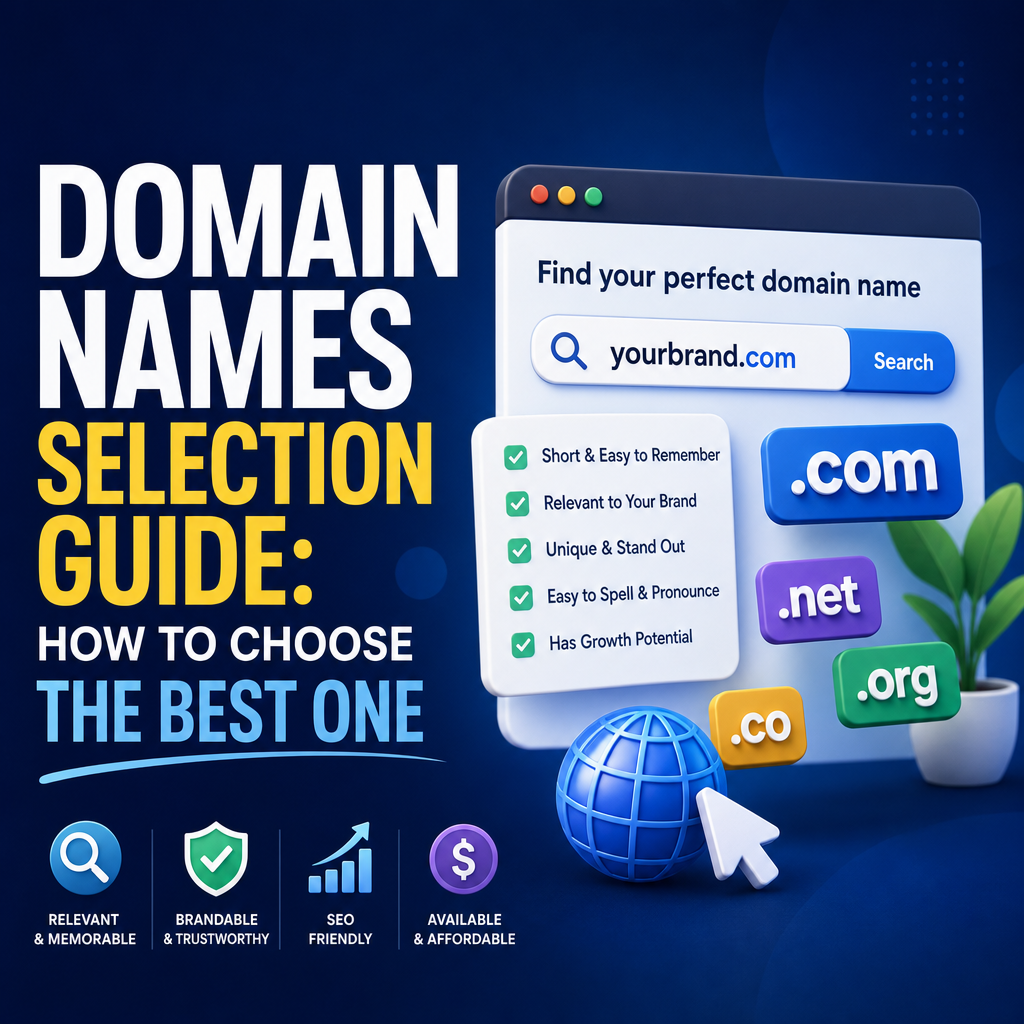
Domain Name Selection Guide
Choosing the right domain name is one of the most important early decisions for any website. Your domain is more than a web address—it is part of your brand identity, first impression, and long-term online strategy. A strong domain can make your site easier to remember, easier to trust, and easier to promote.
This guide walks through the key factors to consider when selecting domain names, along with practical examples and common mistakes to avoid.
Why Domain Names Matter
Your domain name is often the first thing people see when they find your website. It appears in search results, social media shares, email addresses, and printed materials. Because of that, it influences both credibility and visibility.
A good domain name can help you:
- Build brand recognition
- Make your website easier to remember
- Improve trust with visitors
- Support marketing and word-of-mouth referrals
- Create a consistent professional image
For example, compare freshbakes.com and fresh-bakes-2025-online.net. The first is cleaner, more memorable, and easier to type. The second feels cluttered and less trustworthy. Even before a visitor sees your website, the domain gives them a sense of what to expect.
Start With Your Brand and Purpose
Before brainstorming domain names, clarify what your website is for. Are you building a personal brand, launching a business, creating a blog, or selling products? The purpose of your site should shape the domain you choose.
Brand-focused websites
If your website represents a company or personal brand, the domain should usually match the brand name as closely as possible. This makes it easier for people to recognize you across channels.
Examples:
northriverstudio.comjuliakhan.combrightpathdesign.com
Niche-focused websites
If your site is built around a topic rather than a brand name, you might choose a domain that reflects the niche clearly.
Examples:
urbanvegancooking.comsimplehomebudget.comtrailrunnerguide.com
Product or service websites
For a business site, the domain should feel professional and easy to trust. It can include the brand name, a service descriptor, or both.
Examples:
oakandstoneinteriors.comswiftbookkeeping.comgreenfielddental.com
The best domain names fit the purpose of the site without trying to explain everything at once.
Keep It Short and Easy to Remember
Shorter domain names are usually better. They are easier to type, easier to say, and less likely to be misspelled. While you do not need the shortest possible name, you should aim for simplicity.
Why shorter is better
A shorter domain:
- Reduces typing errors
- Looks cleaner in logos and marketing
- Is easier to share verbally
- Feels more professional
Good examples
mintleaf.comlakesidepress.comcodecraft.com
Less effective examples
bestqualityorganiccoffeeonline.comyourtrustedlocalhomeimprovementservices.comtheultimateguideforthebestworkoutplans.com
Long domains are difficult to remember and often look spammy. If your ideal name is too long, try simplifying it or using a more concise brand name.
Make It Easy to Spell and Pronounce
If people hear your domain name in a conversation or podcast, they should be able to type it without confusion. The best domain names are intuitive and easy to pronounce.
Tips for clarity
- Avoid unusual spellings unless they are central to your brand
- Avoid words that are often misspelled
- Say the domain out loud to test how it sounds
- Ask a few people to spell it after hearing it once
Example
A name like kreatekloud.com may look stylish, but it creates friction because users may not know whether to spell it with a “c” or “k,” or whether “cloud” is spelled traditionally. A more straightforward version such as creativecloud.com would be easier to remember, though it may already be taken.
If your preferred choice is unavailable, look for a variation that stays clear and readable rather than forcing a clever but confusing spelling.
Choose the Right Extension
The extension, or top-level domain, is the part at the end of a web address. The most familiar option is .com, but many other extensions exist, such as .org, .net, .co, and industry-specific options like .studio or .shop.
Common extensions and when to use them
- .com – Best for most businesses and personal brands because it is the most recognized
- .org – Often used by nonprofits, communities, and mission-driven organizations
- .net – A backup option, though less common today
- .co – Popular with startups and modern brands
- .io – Common in tech and software
- Industry-specific extensions – Can work well if they fit the brand, such as
.design,.photography, or.shop
Should you always choose .com?
If .com is available and affordable, it is usually the safest choice. People naturally assume a website ends in .com, and that familiarity can help reduce errors. However, if your brand fits another extension better or the .com version is unavailable, a strong alternative can still work well.
The key is consistency and trust. A clear, relevant extension is better than a forced .com that doesn’t match your brand.
Avoid Hyphens and Numbers When Possible
Hyphens and numbers can make domain names harder to remember and more difficult to communicate. They often create confusion when spoken aloud or typed quickly.
Why they can hurt usability
- People may forget where the hyphen goes
- Numbers can be interpreted as digits or words
- The domain may look less polished
- It becomes harder to share on voice calls or podcasts
Example
Consider:
best-cake-shop.combestcakeshop.com
The second version is simpler and easier to type. The first may still work if the clean version is unavailable, but it adds friction.
Numbers are especially tricky. For example, studio4you.com may be fine if “4” is part of the brand, but many users may type studioforyou.com instead.
When possible, choose domain names that do not rely on punctuation or numbers.
Think About Long-Term Flexibility
A domain name should serve you not just today, but for years to come. Avoid choices that are too narrow if you plan to expand your brand later.
Example of a restrictive name
Imagine a business called onlyweddingcakes.com. That may work if the company will forever focus only on wedding cakes. But what if the business later expands into birthday cakes, catering, or baking classes? The domain could become limiting.
A broader name like sweetstudiobakery.com gives more room to grow.
Ask yourself
- Will this domain still fit if my business expands?
- Does it limit me to one product, city, or service?
- Could the name still work if my branding evolves?
Choosing flexible domain names helps protect your future options.
Check for Brand Conflicts
Before registering a domain, make sure it is not too similar to an existing brand or trademark. Even if the domain is technically available, it may still create legal or branding issues.
What to look for
- Existing businesses with the same or similar name
- Trademark registrations in your industry
- Social media handles that match or conflict
- Companies in your region using a similar identity
Why this matters
If your domain is too close to another brand, visitors may confuse the two. You may also face legal disputes or be forced to rebrand later, which can be expensive and disruptive.
A quick search online can reveal whether the name is already widely used. If you are building a serious business, consider a more thorough trademark check before committing.
Test How the Domain Looks and Feels
A domain should not only sound good—it should also look good. Visual appearance matters in logos, headers, email addresses, and promotional materials.
Evaluate the visual style
Look at the domain in lowercase, uppercase, and as part of a logo concept.
Examples:
blueharbor.comBlueHarbor.comBLUEHARBOR.COM
Some names look clean and balanced. Others may look awkward because of repeated letters, confusing word breaks, or hard-to-read combinations.
Watch for accidental meanings
Certain domains can create unintended jokes or awkward phrases when read quickly. For example, if two words run together without much distinction, the result might be confusing or embarrassing.
Say the domain slowly and read it in context:
- Does it sound professional?
- Could it be misread?
- Does it create a strange phrase when written without spaces?
A few minutes of review can save you from a branding mistake.
Use Keywords Wisely
Many people wonder whether domain names should include keywords. In the past, exact-match keyword domains were often used for SEO purposes. Today, the value of keywords is more about clarity than ranking advantage.
When keywords help
A keyword can be useful if it helps visitors quickly understand your website.
Examples:
denverbikefix.comveganmealprep.comfamilylawresources.com
These names instantly communicate what the site is about.
When keywords hurt
Overstuffing a domain with keywords can make it look generic or spammy.
Less effective examples:
bestcheapdenverbikeservice.comveganmealpreprecipeideasandtips.com
Instead of forcing keywords into the domain, focus on a name that is memorable and brandable. You can always use keywords in your page titles, headings, and content.
Check Availability Across Channels
Before finalizing your choice, see whether the name is available beyond the domain itself. A strong online brand often works best when the domain, social handles, and business name align.
Check these areas
- Domain availability
- Social media usernames
- Email address options
- Business registration availability
- Trademark status if relevant
Why consistency matters
If your website is riverstonecreative.com, but your social handle is riverstonecreative123, your brand becomes harder to recognize. Matching names create a smoother experience and make your business easier to find.
If the exact name is not available everywhere, aim for the closest clean version possible.
Use a Simple Decision Process
When comparing potential domain names, it helps to score them against a few practical criteria.
Ask these questions
- Is it short and easy to remember?
- Is it easy to spell and pronounce?
- Does it match my brand or purpose?
- Is the extension appropriate?
- Is it flexible enough for future growth?
- Is it free from legal or brand conflicts?
- Does it look professional in print and online?
If a domain passes most of these checks, it is probably a strong candidate.
Example comparison
Suppose you are choosing between:
summitwellness.comthesummitwellnessandhealthcenter.comsummit-wellness-2025.com
The first option is cleaner, more memorable, and easier to use. Even if the others are descriptive, they are less practical for everyday branding.
Common Mistakes to Avoid
Here are some of the most common errors people make when selecting domain names:
- Choosing something too long
- Using unusual spellings that cause confusion
- Adding unnecessary hyphens or numbers
- Picking a name that is too narrow
- Ignoring trademark issues
- Settling for a domain that is hard to pronounce
- Failing to check social media and brand availability
- Choosing a name that sounds trendy but won’t age well
A domain name should be useful, not just clever. Simplicity and clarity almost always win over complexity.
Conclusion
The best domain names are simple, memorable, and aligned with your brand goals. A good choice should be easy to spell, easy to say, and flexible enough to grow with your website over time. While it can be tempting to chase the perfect creative idea, the most effective domains usually combine clarity with professionalism.
Take your time, compare options carefully, and choose a name that supports both your present needs and future plans. A strong domain is not just an address—it is a foundation for your online presence.
