
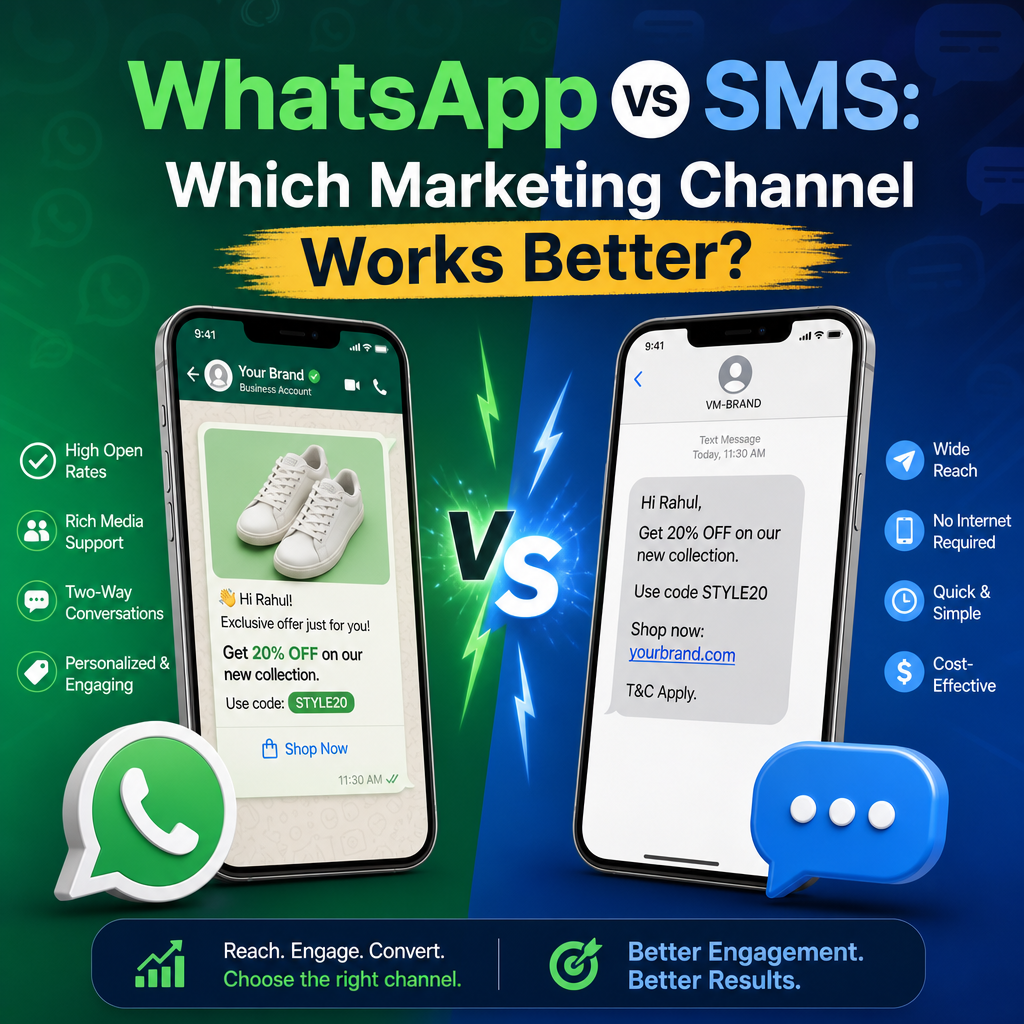
WhatsApp vs SMS Marketing: Which Channel Works Better for Your Business?
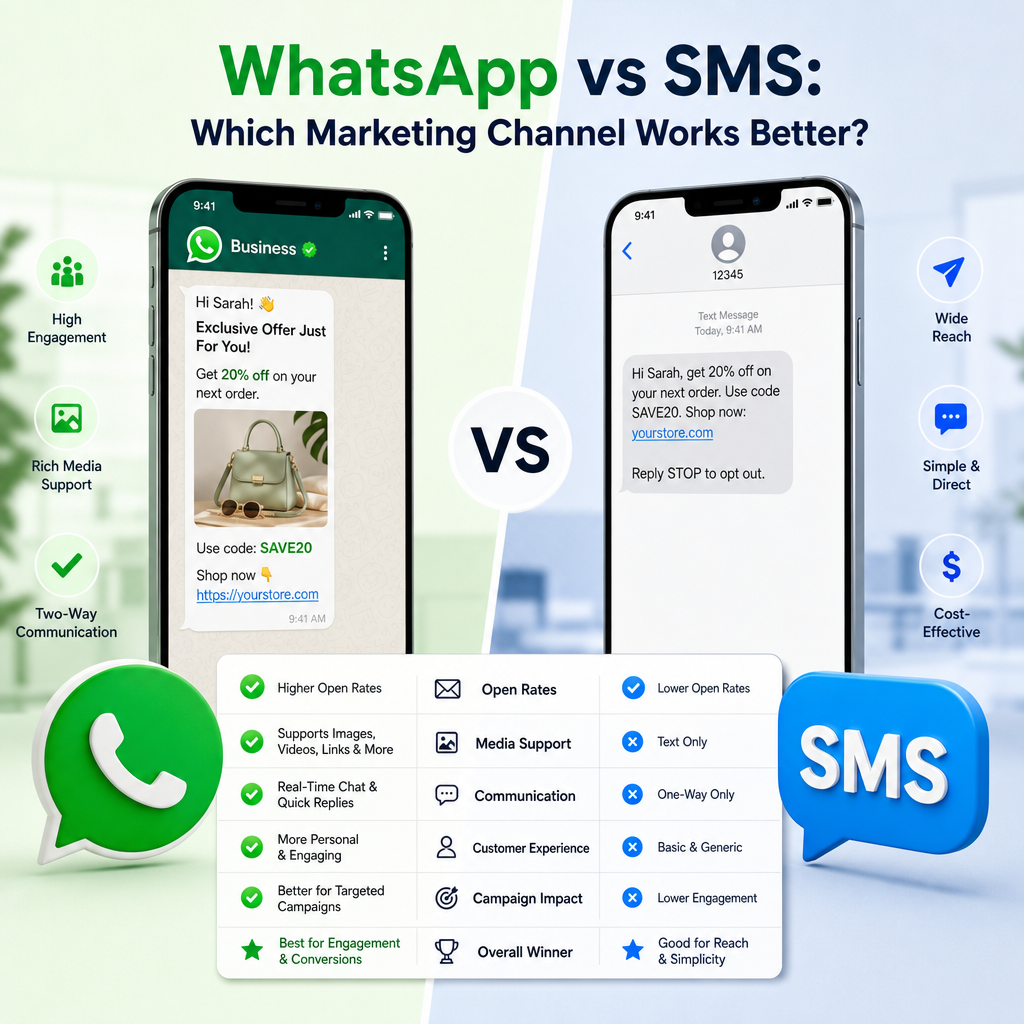
When businesses compare whatsapp vs sms marketing, the real question is not which channel is newer or more popular, but which one is better for reaching the right audience at the right time. Both channels are direct, personal, and effective. Both can drive engagement, sales, and customer loyalty. Yet they work in very different ways.
SMS has been around for decades and remains one of the most reliable communication tools in the world. WhatsApp, on the other hand, has become a dominant messaging platform for real-time conversations, rich media, and interactive customer support. For marketers, understanding the strengths and limitations of each platform is essential before deciding where to invest time and budget.
This article breaks down the key differences between WhatsApp and SMS marketing, including deliverability, engagement, costs, automation, compliance, and use cases. By the end, you’ll have a clearer idea of which channel fits your business goals.
What Is SMS Marketing?
SMS marketing uses text messages sent through the mobile network to communicate with customers. These messages are typically limited to 160 characters per segment, though longer messages can be split into multiple parts.
Businesses use SMS to send:
- Promotional offers
- Appointment reminders
- Shipping updates
- Verification codes
- Event notifications
- Loyalty program alerts
Because SMS does not require an app or internet connection, it reaches nearly every mobile phone user. This makes it one of the most accessible marketing channels available.
What Is WhatsApp Marketing?
WhatsApp marketing uses the WhatsApp platform to send messages, engage leads, and offer customer support. It can include text, images, videos, documents, voice notes, buttons, and quick replies.
Businesses often use WhatsApp for:
- Customer support
- Abandoned cart reminders
- Product recommendations
- Order confirmations
- Appointment booking
- Personalized promotions
WhatsApp feels more conversational than SMS. Instead of a one-way message, it often creates a two-way interaction, making it especially useful for brands that want to build relationships.
WhatsApp vs SMS: Key Differences
At a glance, both platforms seem similar because they deliver messages directly to users. But the experience and marketing potential are quite different.
1. Reach and Accessibility
SMS has the broadest reach. Almost every mobile phone supports SMS, including basic phones without internet access. This gives it a clear advantage when your audience may not use smartphones or may have limited data access.
WhatsApp requires:
- A smartphone
- The WhatsApp app installed
- Internet access
That means WhatsApp’s reach is narrower in some markets, but in countries where WhatsApp is widely used, its penetration can be extremely high. In many regions, users check WhatsApp more often than email or SMS.
Example:
A local clinic sending appointment reminders may prefer SMS if it serves older customers or people with basic phones. A fashion brand targeting young, app-savvy shoppers may get more engagement from WhatsApp.
2. Message Format and Rich Media
SMS is simple and text-based. That simplicity is useful, but it also limits creativity. You cannot easily include images, videos, product catalogs, or interactive buttons.
WhatsApp is built for rich communication. It supports:
- Images
- Video clips
- PDFs and brochures
- Location sharing
- Clickable buttons
- Quick reply options
This makes WhatsApp much better for storytelling, product showcases, and guided conversations.
Example:
An online furniture store can send a WhatsApp message with a product photo, price, and a “Shop Now” button. The same offer through SMS would rely on plain text and a link.
3. Engagement and Response Rates
In most cases, WhatsApp offers stronger engagement than SMS because it feels more personal and interactive. Users are already comfortable chatting on the platform, so they are more likely to respond.
SMS still performs well, especially for urgent or short messages, but response rates can be lower for promotional campaigns because the format feels more transactional.
WhatsApp usually performs better for:
- Conversations
- Lead qualification
- Support
- Personalized campaigns
SMS often performs better for:
- Time-sensitive alerts
- One-time reminders
- Simple call-to-action messages
If your goal is to get a quick reply or start a conversation, WhatsApp often wins. If your goal is to send a short, immediate notification that almost everyone will see, SMS remains extremely effective.
4. Personalization
Both channels allow personalization, but WhatsApp takes it further. SMS can include a name or custom offer, but the message structure is still limited. WhatsApp lets you create more natural, tailored experiences.
For example, a travel agency can send:
- A personalized flight reminder via SMS
- A detailed itinerary with hotel details, maps, and check-in instructions via WhatsApp
The second message feels much more helpful and complete.
Personalization becomes even more powerful when combined with automation. WhatsApp can guide users based on their choices, while SMS usually stays linear.
5. Automation and Chatbots
Both SMS and WhatsApp support automation, but WhatsApp offers more advanced interaction patterns.
With SMS, automation is often used for:
- Delivery confirmations
- Appointment alerts
- Keyword-based responses
- Verification workflows
WhatsApp can do all of that and more, plus:
- Interactive chatbots
- Menu-driven conversations
- Lead qualification flows
- Product browsing
- Customer service routing
Example:
A restaurant can use WhatsApp automation to let customers browse the menu, reserve a table, and receive a confirmation in the same chat. SMS could send a reservation link, but it would not create the same smooth user experience.
6. Costs and Budget
SMS pricing is usually straightforward: businesses pay per message or message bundle. Costs can add up quickly when sending large campaigns, especially across multiple regions.
WhatsApp Business Platform pricing is different. It often involves conversation-based pricing, with costs depending on the type of message and region. While this can be efficient for longer interactions, it may be more complex to manage than SMS pricing.
In general:
- SMS is easier to understand and budget for
- WhatsApp can be more cost-effective for high-engagement, multi-message conversations
- Large-scale SMS campaigns can become expensive quickly
- WhatsApp may reduce costs by handling more value in one conversation
The better option depends on message volume, audience location, and campaign length.
7. Compliance and Consent
Both WhatsApp and SMS marketing require user consent. Privacy laws and platform policies are strict, and ignoring them can lead to penalties or blocked accounts.
For SMS, businesses typically need explicit opt-in and must provide clear opt-out instructions.
For WhatsApp, users must also opt in to receive messages, and businesses need to follow platform rules regarding message templates and customer communication windows.
Important compliance practices include:
- Collecting clear consent
- Explaining what users will receive
- Offering an easy opt-out method
- Respecting quiet hours
- Avoiding spam-like frequency
Compliance is not just a legal requirement. It also protects deliverability and brand trust.
8. Deliverability and Open Rates
SMS has excellent deliverability because it bypasses app algorithms and inbox filters in the way email does. Most text messages are opened quickly, often within minutes.
WhatsApp also has very high open rates, especially since users tend to check messages frequently. However, deliverability depends on users having the app installed, being reachable on WhatsApp, and not blocking your business.
In practice:
- SMS is dependable for universal delivery
- WhatsApp is highly visible within its user base
- Both channels outperform email in speed and open rates
If your campaign needs guaranteed reach across a broad audience, SMS has an edge. If your audience already uses WhatsApp actively, the platform can generate even stronger engagement.
When SMS Marketing Is the Better Choice
SMS is best when you need speed, simplicity, and universal accessibility.
Choose SMS when you want to:
- Reach nearly everyone instantly
- Send urgent updates
- Communicate with customers who may not use WhatsApp
- Keep messages short and clear
- Deliver security codes or alerts
- Run lightweight reminder campaigns
Good SMS Marketing Examples
- “Your package will arrive today between 3–5 PM.”
- “Your 2 PM appointment has been confirmed.”
- “Flash sale: 20% off until midnight. Shop here: [link]”
These messages are fast, functional, and easy to digest.
When WhatsApp Marketing Is the Better Choice
WhatsApp is best when you want richer interaction, stronger engagement, and more personalized customer journeys.
Choose WhatsApp when you want to:
- Send product visuals or documents
- Build conversational marketing flows
- Provide customer support
- Guide users through a buying process
- Share detailed updates or instructions
- Improve lead qualification
Good WhatsApp Marketing Examples
- A real estate agent sending property photos, pricing, and location details
- A salon allowing clients to book appointments through quick reply buttons
- An e-commerce brand sending cart reminders with product images and discount codes
- A tuition center sharing schedules, PDFs, and live responses to parent questions
WhatsApp excels when the message is more than just an alert. It works best when it becomes part of a conversation.
How to Choose Between WhatsApp and SMS
The best choice depends on your audience, message type, and business goals. In many cases, the answer is not one or the other, but both.
Use this simple framework:
Use SMS if:
- Your audience is broad and mixed
- You need maximum reach
- The message is short and urgent
- You are sending reminders or alerts
- You want a simple, low-friction channel
Use WhatsApp if:
- Your customers are already active on the app
- You want richer media and interactive responses
- Your campaign requires conversation
- You need to nurture leads or provide support
- You want a more modern customer experience
Use both if:
- You want SMS for alerts and WhatsApp for engagement
- You need to cover different audience segments
- You want fallback messaging if one channel is unavailable
- You are building a customer communication strategy across the full journey
For example, an online retailer might use SMS for delivery alerts and WhatsApp for personalized recommendations, post-purchase support, and abandoned cart recovery. This combination can improve both speed and depth of engagement.
Common Mistakes to Avoid
No matter which channel you choose, a few common mistakes can reduce performance.
Sending Too Many Messages
Over-messaging leads to fatigue and unsubscribes. Keep communication useful and timely.
Being Too Generic
Messages that feel mass-produced get ignored. Use personalization where possible.
Ignoring Consent
Never message people who have not opted in. It hurts trust and may violate regulations.
Overcomplicating the Message
A message should have a clear purpose. Whether you use WhatsApp or SMS, avoid clutter and unnecessary detail.
Not Matching Channel to Goal
Do not use WhatsApp for a simple urgent alert if SMS would work better. Do not use SMS for a rich, interactive campaign if WhatsApp would create a better experience.
The Future of WhatsApp vs SMS Marketing
The conversation around whatsapp vs sms is likely to continue as customer expectations evolve. SMS will remain essential because of its reliability and universal access. It is not going away anytime soon.
WhatsApp, however, is expanding what direct messaging can do. As more businesses adopt chat-based commerce, interactive support, and automation, WhatsApp will likely become an even more important marketing tool.
The future is probably not a single winning channel. It is a smarter mix of both.
Businesses that understand when to use SMS and when to use WhatsApp will have a stronger advantage than those that rely on just one platform.
Conclusion
When comparing WhatsApp vs SMS marketing, there is no universal winner. SMS is unbeatable for reach, simplicity, and urgent communication. WhatsApp is stronger for engagement, personalization, and interactive customer experiences.
If your audience is broad and you need instant delivery, SMS is a solid choice. If your goal is to create conversation, share rich content, and support the customer journey, WhatsApp is often the better fit. In many cases, the smartest strategy is to use both channels together, each for what it does best.
By choosing the right channel for the right message, your marketing becomes more effective, more relevant, and more valuable to your customers.
