
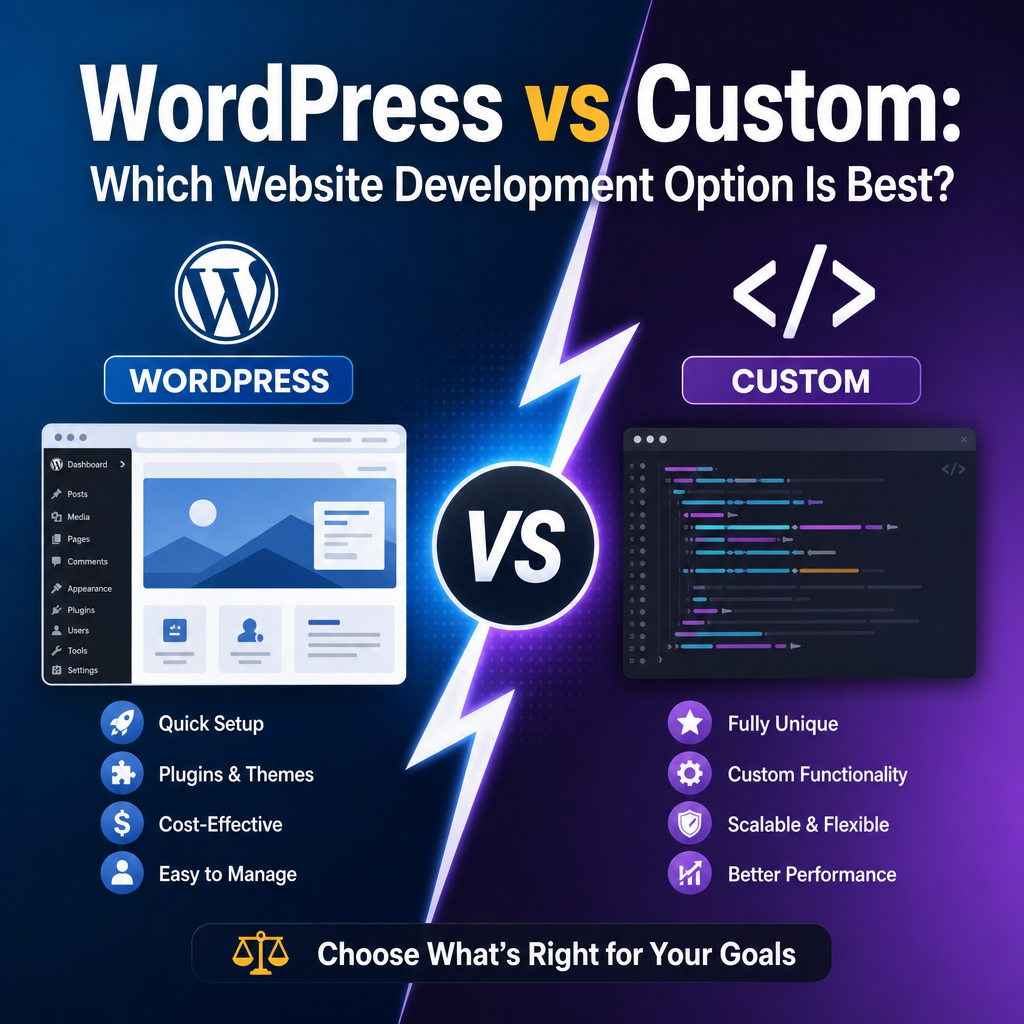
WordPress vs Custom Development: Which Is the Right Choice for Your Website?
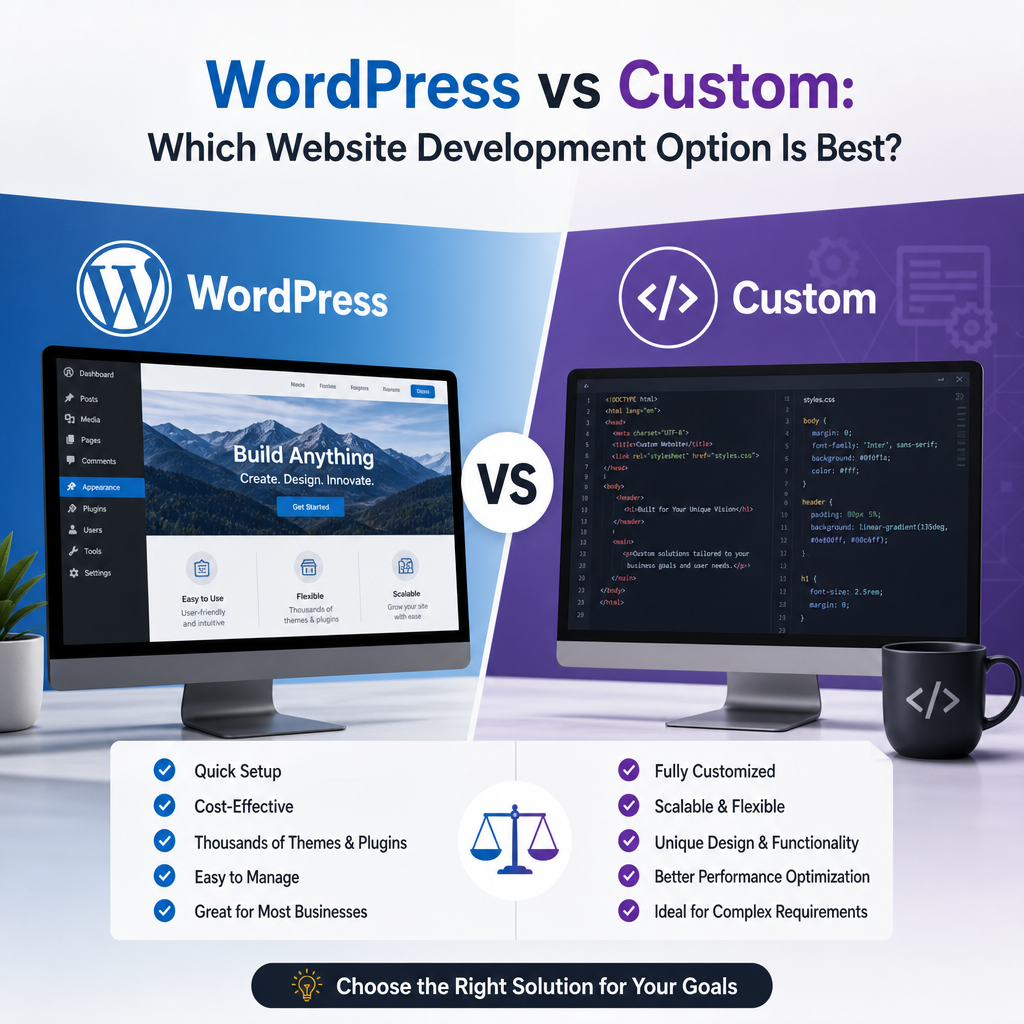
Choosing between WordPress and custom development is one of the most important decisions you can make when building a website. The choice affects your budget, timeline, flexibility, maintenance requirements, and long-term scalability. For many businesses, the debate around wordpress vs custom comes down to a simple question: do you want a faster, more affordable solution, or a fully tailored digital product built around your exact needs?
There is no universal winner. WordPress is ideal for many websites, especially when speed and cost matter. Custom development shines when your project requires unique functionality, complex integrations, or complete control over every part of the experience. The right answer depends on your goals, your technical resources, and how much you expect your website to evolve.
What Is WordPress?
WordPress is a content management system, or CMS, that lets you build and manage websites without coding everything from scratch. Originally created for blogging, it now powers a huge portion of the web, from small business sites to large publications and online stores.
With WordPress, you can use:
- Pre-built themes for design
- Plugins for added functionality
- A visual editor for content updates
- An admin dashboard for site management
This makes WordPress attractive to businesses that need a website up quickly and want non-technical team members to update pages, posts, images, or product listings.
Why WordPress Is Popular
WordPress is popular because it lowers the barrier to entry. Instead of hiring a full development team for every feature, you can often install a theme or plugin to get the job done. For example, a local restaurant can launch a site with pages for menus, reservations, and contact information without paying for a fully custom platform.
Other common reasons businesses choose WordPress include:
- Lower upfront cost
- Faster launch time
- Large ecosystem of plugins and themes
- Easy content editing
- Strong community support
What Is Custom Development?
Custom development means building a website or web application from the ground up, usually with programming frameworks and tools chosen specifically for the project. Instead of relying on a CMS’s default structure, developers create the functionality, design, and user experience according to exact business requirements.
A custom-built site might use technologies such as:
- Laravel
- Django
- Ruby on Rails
- Next.js
- React
- Node.js
This approach is often used for businesses that need specialized workflows, advanced user systems, complex databases, or integrations with other software.
When Custom Development Makes Sense
Custom development is a strong choice when your website must do more than present information. For example, a SaaS company may need a customer portal with role-based permissions, analytics dashboards, and third-party API integrations. A marketplace may need product filtering, vendor profiles, secure payments, and custom reporting. These are cases where forcing a WordPress plugin stack to handle everything could become inefficient or fragile.
WordPress vs Custom: Key Differences
When comparing wordpress vs custom, the biggest differences are usually found in cost, speed, flexibility, maintenance, and scalability. Understanding these trade-offs helps you avoid choosing a platform that works against your long-term goals.
1. Cost
WordPress generally has a lower initial cost. You can launch a site using a theme, a few plugins, and modest development work. Even if you hire a designer or developer, the total cost is often far less than a fully custom build.
Custom development usually requires a much larger investment. You are paying for planning, design, development, testing, and often ongoing support. That said, the higher upfront cost may be justified if the website becomes a critical business tool.
Example
A consulting firm may only need a branded site with service pages, testimonials, and a contact form. WordPress can handle that affordably.
A financial platform, however, may need secure document handling, advanced user permissions, and custom workflows. In that case, custom development may be the better long-term investment.
2. Speed of Launch
WordPress is typically much faster to launch. Themes and plugins reduce the time needed to build core features. Many websites can go live in days or weeks.
Custom development takes longer because every piece must be planned and built. Even a simple custom site can take several weeks, while a more complex product may require months.
If time to market is critical, WordPress often wins.
3. Flexibility
Custom development offers maximum flexibility. You are not limited by the design patterns, plugin architecture, or content structures of a CMS. This is useful when your site needs unique functionality or an unusual user experience.
WordPress is flexible too, but only up to a point. You can customize themes, extend functionality with plugins, and even create custom post types. However, as the requirements become more specialized, you may run into plugin conflicts, performance issues, or limitations in the platform’s architecture.
4. Maintenance
WordPress sites require ongoing maintenance. Themes, plugins, and the core platform all need updates. If updates are neglected, security risks and compatibility problems can arise. Plugin-heavy sites may also become harder to manage over time.
Custom websites also require maintenance, but the nature of that maintenance is different. You typically have fewer third-party dependencies, but updates and fixes often require developers. Maintenance can be more predictable, yet it may not be as easy to handle internally.
5. Scalability
Both WordPress and custom development can scale, but they do so differently.
WordPress can support large websites when properly built and optimized. High-traffic content sites and eCommerce stores often use it successfully. But as complexity increases, scaling can become harder if the site depends on many plugins or a poorly structured database.
Custom development is usually more scalable for highly specialized systems. Since the architecture is built for your exact use case, it can be optimized for growth, performance, and advanced workflows from the beginning.
Pros and Cons of WordPress
WordPress is not just a “cheap option.” It is a serious platform with major advantages. Still, it is not perfect for every situation.
Pros
- Lower development cost
- Faster time to launch
- Easy for non-technical users to manage
- Huge library of plugins and themes
- Strong SEO capabilities
- Large support community
- Suitable for blogs, business sites, and many eCommerce stores
Cons
- Plugin conflicts can cause issues
- Security depends on proper maintenance
- Custom features can become difficult to manage
- Performance can suffer with too many plugins
- Design and functionality may be limited by theme architecture
Best Use Cases
WordPress is often a great fit for:
- Small business websites
- Blogs and content marketing sites
- Portfolios
- Brochure-style websites
- Basic eCommerce stores
- Membership sites with common requirements
Pros and Cons of Custom Development
Custom development gives you more control, but it also introduces more complexity.
Pros
- Full control over design and features
- Better fit for unique workflows
- More efficient architecture for specific needs
- Easier to create proprietary systems
- Better integration with internal tools and APIs
- Strong long-term potential for custom products
Cons
- Higher upfront cost
- Longer development time
- Requires technical expertise for updates
- More expensive to modify if requirements change
- Can be overkill for simple websites
Best Use Cases
Custom development is often ideal for:
- SaaS platforms
- Marketplaces
- Internal business tools
- Complex booking systems
- Web applications with unique workflows
- High-performance sites with specialized requirements
Real-World Examples
Sometimes the easiest way to understand wordpress vs custom is to look at real scenarios.
Example 1: A Local Bakery
A local bakery needs a website with a homepage, menu, gallery, hours, and contact form. They also want to update seasonal specials occasionally.
WordPress is a perfect fit. It allows the bakery to get online quickly, manage content themselves, and avoid unnecessary development expense.
Example 2: A Growing SaaS Startup
A software startup needs a marketing site, customer dashboard, subscription management, usage analytics, and API integrations with other tools.
This is a better candidate for custom development. While WordPress might work for the marketing page alone, the product side requires a more robust and tailored system.
Example 3: An Online Magazine
A digital publication publishes articles daily and needs categories, author profiles, editorial workflows, and strong SEO capabilities.
WordPress is often ideal here because content publishing is its strength. With the right setup, the editorial team can manage content efficiently without depending on developers for every update.
Example 4: A Custom Booking Platform
A business offering complex reservations needs dynamic scheduling, user logins, custom pricing, notifications, and admin controls.
This usually calls for custom development. Although WordPress booking plugins exist, they may not provide the exact logic or reliability required for a mission-critical system.
SEO Considerations
SEO is often part of the decision between WordPress and custom development. WordPress has a strong reputation for SEO because it makes it easy to manage metadata, headings, content structure, image alt text, and plugins like SEO tools.
Custom development can also be SEO-friendly, but only if the development team builds it correctly. Clean code, fast page speeds, semantic HTML, structured data, and mobile optimization all matter. A custom site with poor implementation can easily underperform a well-built WordPress site.
WordPress SEO Strengths
- Easy content creation
- SEO plugins simplify optimization
- Fast publishing workflow
- Great for content marketing and blogs
Custom SEO Strengths
- Better control over page performance
- Cleaner codebase when built well
- Tailored technical SEO structure
- Potential for advanced page-level optimization
In practice, SEO success depends more on execution than platform alone. A fast, well-structured WordPress site can outrank a poorly developed custom site, and vice versa.
Security and Performance
Security and performance are major concerns in any website project.
WordPress can be secure, but it requires disciplined maintenance. Because it uses plugins and third-party themes, the attack surface can be larger. Choosing reputable plugins, keeping everything updated, and using strong hosting are essential.
Custom development typically has fewer off-the-shelf dependencies, which can improve security. However, custom code is only as secure as the team that builds it. A poorly written custom application may be more vulnerable than a well-maintained WordPress site.
Performance follows a similar pattern. A lean custom site can be extremely fast, but a bloated one can also be inefficient. WordPress can be fast too, especially with quality hosting, caching, and minimal plugin use. The problem usually lies not in the platform itself, but in how it is implemented.
How to Choose Between WordPress and Custom Development
If you are still deciding, ask these questions:
-
What is the primary purpose of the website?
If it is mainly content publishing or lead generation, WordPress may be enough. -
How unique are the features?
If the site needs custom workflows, advanced integrations, or proprietary functionality, custom development may be better. -
What is your budget?
Lower budget usually favors WordPress. Larger budgets open the door to custom builds. -
How quickly do you need to launch?
WordPress is usually faster. -
Who will maintain the site?
If your internal team needs to update content independently, WordPress is easier to manage. -
Will the website become a core product?
If the website itself is central to your business model, custom development may offer better long-term value.
A Simple Rule of Thumb
- Choose WordPress if you want speed, affordability, and manageable complexity.
- Choose custom development if you need precision, unique functionality, and long-term scalability for a specialized product.
Conclusion
The wordpress vs custom decision is not about which platform is universally better. It is about matching the solution to the job. WordPress is a powerful option for businesses that need a professional website without the expense and complexity of building from scratch. Custom development is the right choice when your website must support specialized workflows, advanced features, or a truly unique user experience.
If your needs are straightforward, WordPress will likely save time and money while still delivering excellent results. If your project is more complex and business-critical, custom development can provide the control and scalability you need. The best choice is the one that fits your goals today while still supporting your growth tomorrow.
