
Rich Communication Services (RCS) vs SMS: What’s the Difference and Why It Matters
Text messaging has been a core part of mobile communication for decades. Most people still rely on SMS every day for quick alerts, verification codes, appointment reminders, and simple conversations. But a new standard is gaining momentum: Rich Communication Services, better known as RCS messaging.
If you’ve heard the term but aren’t exactly sure how it compares with SMS, you’re not alone. RCS is often described as the “next generation of texting,” but that phrase can feel vague unless you understand what it actually changes. In this article, we’ll break down the difference between RCS and SMS, explore the strengths and limitations of each, and explain why businesses and consumers are paying attention.
What Is SMS?
SMS stands for Short Message Service. It is the original text messaging protocol used on mobile phones. SMS has been around since the early 1990s and remains one of the most widely supported communication methods in the world.
Key characteristics of SMS
- Works on virtually all mobile phones
- Uses a cellular network, not internet data
- Supports plain text messages only
- Limited to 160 characters per message segment
- Does not include advanced features like read receipts or media-rich cards
SMS became popular because it is simple, reliable, and universally available. Even if someone has an older phone or weak data access, they can usually still receive SMS messages as long as they have signal.
However, SMS is also basic by design. It was never intended to support modern messaging experiences like typing indicators, group chat controls, or interactive buttons.
What Is RCS?
RCS stands for Rich Communication Services. It is a modern messaging protocol designed to upgrade traditional SMS and MMS with features more commonly associated with apps like WhatsApp, iMessage, or Facebook Messenger.
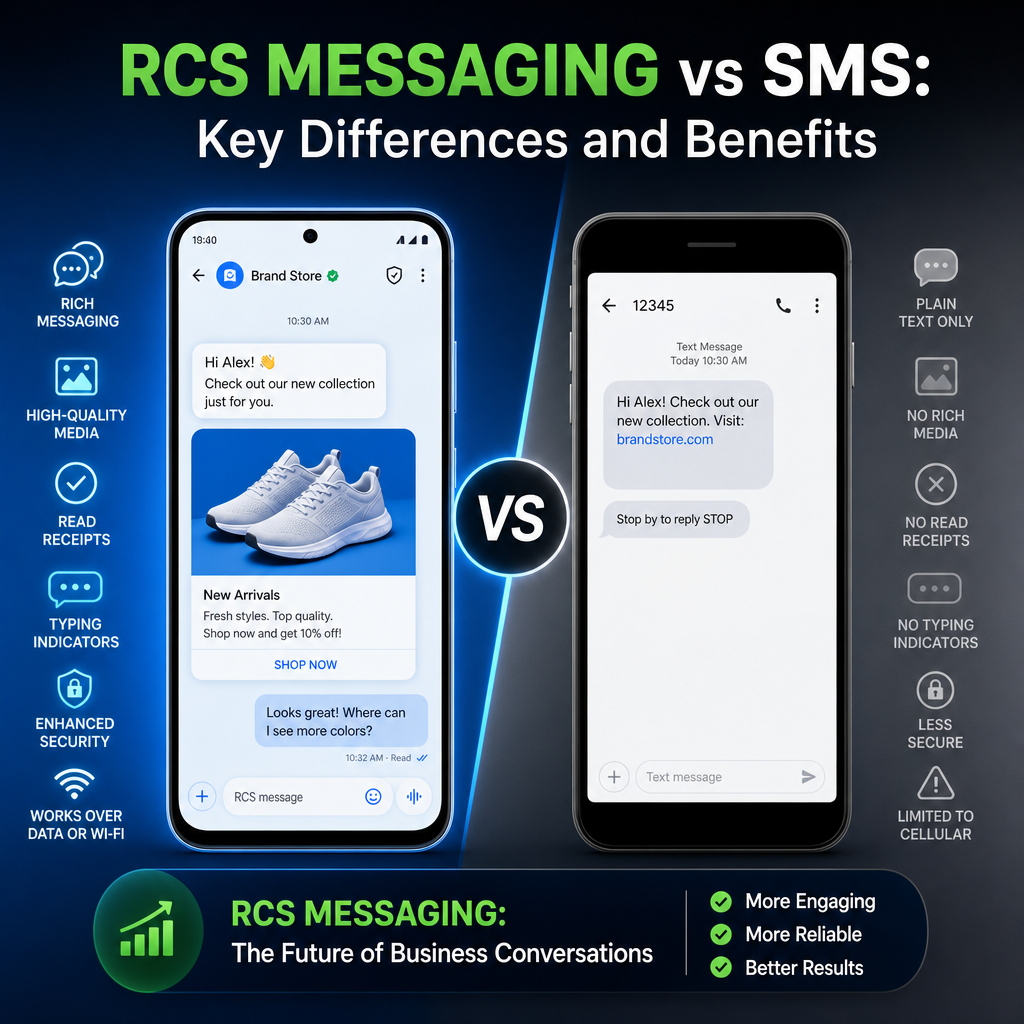
RCS messaging works over mobile data or Wi-Fi and is meant to provide a richer, more interactive texting experience inside a phone’s default messaging app.
Key characteristics of RCS
- Supports high-resolution images, video, and audio
- Allows typing indicators and read receipts
- Enables group messaging improvements
- Can include interactive buttons and suggested replies
- Offers branding and richer layouts for business messaging
- Works through internet connectivity instead of only cellular SMS channels
In simple terms, RCS is trying to make the default texting app feel more modern without requiring users to download a separate app.
RCS vs SMS: The Core Differences
While both RCS and SMS allow people to send messages between phone numbers, they operate very differently. Here are the biggest distinctions.
1. Network connection
SMS:
Uses a carrier’s cellular network. Messages can often still go through without mobile data or Wi-Fi.
RCS:
Uses data or Wi-Fi, similar to internet-based messaging apps.
This means SMS can be more dependable in areas with poor internet access, while RCS offers a richer experience when data connectivity is available.
2. Message content
SMS:
Plain text only. MMS can add images, but it is still limited and often compressed.
RCS:
Supports richer media, including:
- High-quality images
- Video clips
- Audio messages
- Location sharing
- GIFs and more
For example, an SMS notification might say, “Your order has shipped.” An RCS message could show the product image, shipment status, delivery estimate, and a tracking button in the same thread.
3. Interactivity
SMS:
Mostly limited to one-way or simple two-way text.
RCS:
Can support interactive elements such as:
- Quick reply buttons
- Suggested responses
- Action buttons for calling, visiting a website, or opening maps
- Carousel-style cards for products or offers
This makes rcs messaging especially attractive for customer service and marketing.
4. Read receipts and typing indicators
SMS:
Does not natively support these features.
RCS:
Often includes:
- Read receipts
- Delivered status
- Typing indicators
These small features make conversations feel more immediate and human.
5. Character limits and formatting
SMS:
Has a 160-character limit per segment, though longer texts can be split into multiple segments.
RCS:
Offers far more flexibility and is not bound by the same traditional text-only limitations.
6. Branding and identity
SMS:
Usually displays a phone number or short code, with little visual branding.
RCS:
Can include business logos, verified sender profiles, and branded message layouts.
That added trust factor can be a major advantage for companies that want customers to recognize legitimate communications.
Why RCS Messaging Is Gaining Attention
RCS has been discussed for years, but adoption has accelerated because consumers now expect richer digital experiences from every communication channel. Messaging is no longer just about sending words. People want convenience, visuals, and fast actions.
Better customer engagement
Businesses can use rcs messaging to create interactive conversations that drive engagement. Instead of sending a plain text with a URL, a brand can present product cards, appointment options, or live order updates directly in the message thread.
For example:
- A restaurant can send a reservation reminder with buttons to confirm or reschedule
- A retailer can share a new collection with product images and “Shop Now” actions
- A delivery service can provide tracking updates and support options in one thread
These features reduce friction and improve the customer experience.
More professional communication
Because RCS supports branding and verification, messages can feel more legitimate and polished. That matters for banks, healthcare providers, airlines, and ecommerce companies that need to send important updates customers can trust.
A verified RCS message from a bank, for instance, may display the company name and logo rather than just an unknown number. That visual reassurance can help reduce confusion and fraud risk.
Richer conversations without new apps
One of the biggest promises of RCS is convenience. Users don’t have to install a separate app or learn a new interface. The experience is built into the native messaging app on supported devices.
That makes rcs messaging appealing because it combines the familiarity of texting with many of the features people enjoy in dedicated chat apps.
Where SMS Still Has the Advantage
Despite the rise of RCS, SMS is far from obsolete. In fact, SMS remains essential in many situations.
Universal compatibility
SMS works on nearly every mobile phone, including older devices and basic phones. RCS, on the other hand, requires support from the carrier, device, messaging app, and network conditions.
This makes SMS the most dependable option when you need to reach everyone, regardless of technology.
No data required
SMS can be delivered without mobile data or Wi-Fi. That gives it an advantage in low-connectivity environments or when users have limited internet access.
Simplicity
Sometimes simple is best. For short alerts like:
- One-time passcodes
- Weather alerts
- Delivery confirmations
- Appointment reminders
SMS does the job efficiently without added complexity.
Broad reach for critical messages
Because SMS is so widely supported, many organizations still use it for essential communications where deliverability matters more than rich features.
Where RCS Has the Advantage
If SMS is about reach and reliability, RCS is about experience and engagement. It becomes especially powerful in scenarios where message quality and interaction matter.
Marketing campaigns
RCS messaging can make promotional content more engaging. A retail brand could send a new product launch message with:
- Product images
- Pricing
- Recommended items
- A direct purchase button
This is much more compelling than a plain-text link.
Customer support
Support teams can use RCS to guide customers through common actions, such as:
- Checking order status
- Rebooking appointments
- Connecting with a service representative
- Accessing FAQs
These features reduce the number of steps a customer needs to take.
Transactional updates
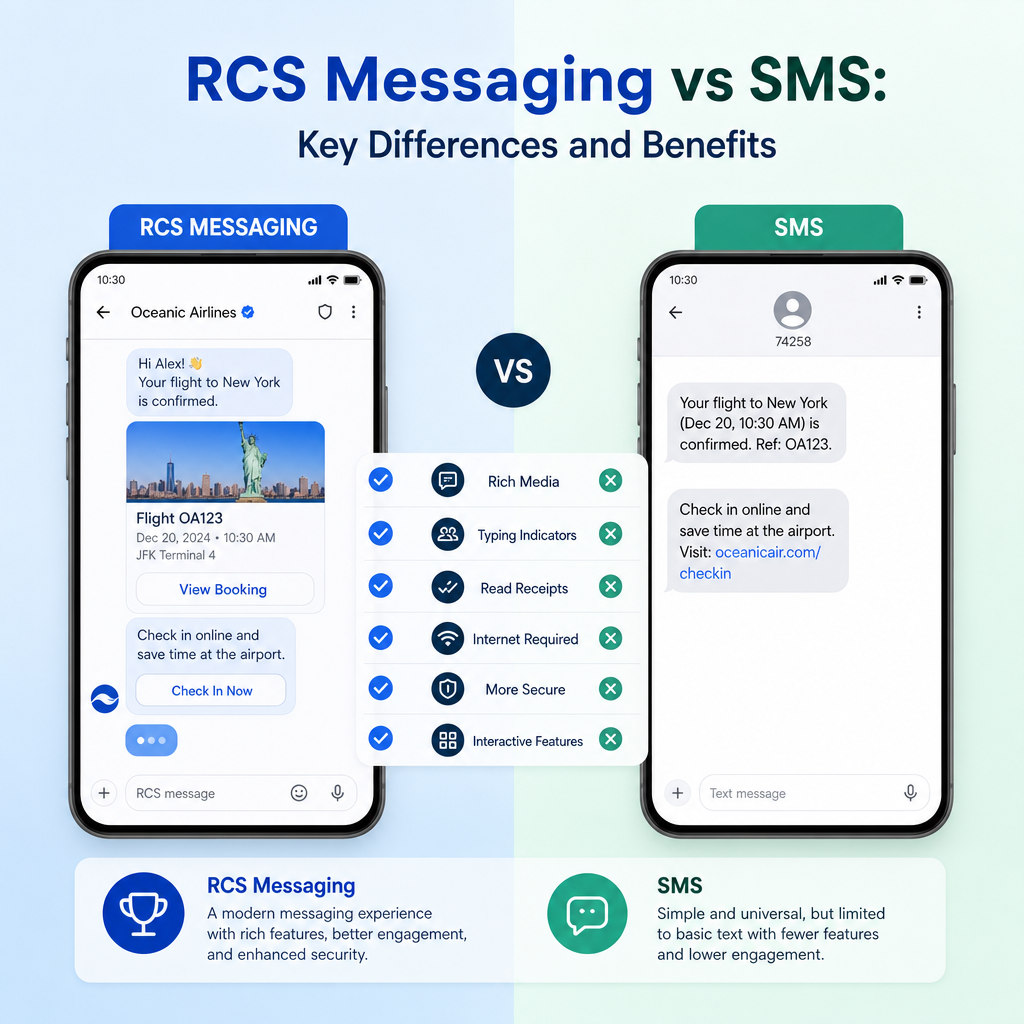
Banks, airlines, shipping companies, and service providers can use richer message formats to make alerts more useful. A flight update can include gate changes, boarding times, and a button to view the itinerary.
Brand trust
Verified sender identity and branded formatting can help organizations look more credible. This is particularly useful in industries where message authenticity matters.
Practical Examples of SMS vs RCS
To understand the difference more clearly, let’s compare how each might handle the same scenario.
Example 1: Appointment reminder
SMS:
“Your dental appointment is tomorrow at 3 PM. Reply C to confirm or R to reschedule.”
RCS:
Displays the clinic’s logo, appointment details, a map to the office, and buttons that say Confirm, Reschedule, and Call Office.
The RCS version is more convenient and visually clear.
Example 2: Product promotion
SMS:
“New summer collection is here. Shop now: [link]”
RCS:
Shows multiple product cards with images, prices, descriptions, and a “Shop Now” button for each item.
The RCS version is more immersive and likely more effective for conversion.
Example 3: Delivery update
SMS:
“Your package will arrive today by 6 PM. Track here: [link]”
RCS:
Includes package status, estimated delivery time, driver updates, and a tracking button inside the message.
Again, RCS creates a smoother experience by reducing the need to jump between apps or websites.
Challenges and Limitations of RCS
RCS sounds impressive, but it is not without issues.
Uneven adoption
Not all carriers, devices, and regions support RCS equally. That means some users may not receive RCS messages at all, or they may be downgraded to SMS automatically.
Dependency on internet access
Because RCS requires data or Wi-Fi, it can be less reliable in low-connectivity situations. SMS still has an edge when internet service is weak or unavailable.
Inconsistent user experience
Depending on the phone, carrier, and messaging app, the RCS experience may differ. That fragmentation can make it harder for businesses to ensure every customer gets the same experience.
Security concerns
RCS generally improves on SMS in many areas, but the security and encryption model can vary depending on the platform and provider. Businesses and users should remain aware of the privacy and security policies of their messaging environment.
Which One Should Businesses Use?
The answer depends on the message and the audience.
Use SMS when:
- You need maximum reach
- The message is short and essential
- The audience may not have data or RCS support
- You are sending critical alerts or verification codes
Use RCS when:
- You want a more engaging customer experience
- Visuals, buttons, and branded content matter
- You are sending promotional or transactional messages
- Your audience is likely using compatible devices and networks
Many organizations will not choose one exclusively. Instead, they may use RCS messaging where supported and fall back to SMS when needed. That hybrid approach offers the best of both worlds: broad coverage and richer interaction.
The Future of Mobile Messaging
The future of texting is clearly moving toward richer and more interactive communication. RCS is a major part of that shift, especially for businesses looking to improve engagement and streamline customer interactions.
Still, SMS is not going away anytime soon. Its simplicity, universality, and reliability make it too important to replace completely. For the foreseeable future, SMS and RCS will likely coexist, each serving different needs.
In many ways, RCS is not a replacement so much as an evolution. It takes the basic idea of texting and adds the modern features users now expect from digital communication.
Conclusion
When comparing Rich Communication Services vs SMS, the difference comes down to capability versus compatibility. SMS remains the most universal and dependable messaging standard, while RCS messaging offers a far richer, more interactive experience.
For everyday alerts and critical notifications, SMS is still highly valuable. But for branded communication, customer engagement, and modern messaging experiences, RCS opens the door to much more than plain text. As adoption grows, more businesses and consumers will likely find themselves using both, depending on the situation.
The result is a messaging landscape that is becoming more flexible, more visual, and more useful than ever before.
